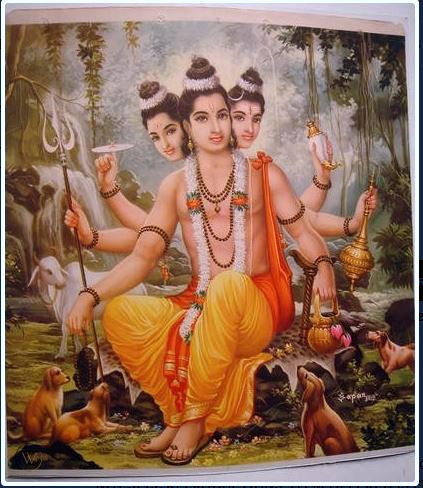



Ether, air, fire, water, earth, planets, all creatures, directions, trees and plants, rivers and seas, they all are organs of God’s body. Remembering this, a devotee respects all species. — Srimad Bhagavata Mahapurana (2.2.41)
Hindu teachings ground environmental conservation in spiritual tradition
Concern for preserving our one shared planet is certainly not something exclusive to any one religious tradition. In the early 21st century each of the major world religious traditions has repeatedly stated how environmental conservation and concern for creating an ecologically more sustainable society finds foundation in their respective theologies. The Hindu Dharma Traditions are no different in this regard.
What sets Hinduism apart is that it offers is a vision of manifest existence in which, from the broadest perspective and in the context of environmental conservation, there is no separation between the creator and the created. At the deepest level, there is no essential separation between the species homo sapiens and the other species of animals, for example, and indeed between humanity and all of the world around us. At the same time that the Hindu worldview recognizes this unity, it also celebrates, revels, and delights even, in the expressed diversity of the Divine that we see all around us every day.
The majority of the world’s billion-plus Hindus live in India and the other nations of South Asia. But environmental concerns like climate change, habitat loss, water scarcity, and air and water pollution are all negatively affecting Hindus no matter where they live.
Despite praiseworthy efforts by the Government of India to tackle climate change, and notable efforts to begin addressing water pollution in the nation’s rivers, considered sacred by Hindus, our children and grandchildren will be likely be left with a far less fertile and hospitable planet than the one we enjoy today and in which human civilization has developed. India is both on the front lines of climate change effects and in attempts to implement solutions to reducing greenhouse gas emissions. Beyond the sacred geography of India, Hindus make up significant minorities in many of the world’s nations historically most-responsible for emitting greenhouse gases, as well as those consuming large amounts of the world’s natural resources. The environmental policies of these nations vary widely in their ambition and effectiveness. Some will be able to adapt in the face of rising sea levels and rising temperatures, as well the changes in land-use that come with growing populations and technological development. Some are less able to do so.
What unites all of the nations of the world is that more must be done. We must, to start, ensure all people have access to clean water, clean electricity, and modern sanitation; reduce deforestation and land degradation, and reduce habitat loss for other species; as well as do all that we can to limit the effects of climate change.
It is imperative that Hindus, throughout the world, do all that we can in furtherance of these things — both in encouraging policymakers and businesses to support these goals and implement policies and practices to achieve them, and by doing all we can that is reasonably within our personal control to live in an ecologically sustainable manner.
The Hindu Dharma Traditions offer much to the world in terms of both philosophy and practices so that we can all live in more ecologically sustainable societies, for the wellbeing of all people and the planet.
Hindu sources of knowledge, when viewed through an ecological lens, provide a strong foundation for action.
The cornerstone of this foundation is the teaching that all is Divine and everything is sacred. There are three main ecological concepts that support this:
Vasudeva Sarvam – The Divine is present in all beings
Vasudhaiva Kutumbakam – Everything is part of one interconnected global family, both spiritually and practically
Sarva Bhuta Hita – Promoting the welfare of all beings is the highest dharma
What these build up to is a sense that at the deepest level there is no distinction in composition between the world we perceive and the Divine. Rather than being created out of a separate substance, the universe and everything in it, the planet we inhabit and everything upon it, is emanated from and embodied by the Divine.
When one looks at the world from this vantage, all of life is worthy of our respect and all our actions can take on an element of veneration. From here the impulse for ecological conservation and regeneration happens easily. When we know and feel that all life is sacred, our behavior and desires change towards naturally wanting to balance our individual needs and desires against how fulfilling them might affect all of life around us.
As exists in all human endeavor, there is a gap between philosophy and practice — this applies to Hindus no more or less than any other grouping of people. It is our responsibility today, facing multiple intertwined ecological crises, to close that gap as much as we can — in our personal lives and in our communities and nations.
From the broadest perspective, a Hindu way of approaching ecological challenges is similar to applying the precautionary principle.
What possible harm are my actions causing other beings?
How sure am I that this harm will result?
Is this harm avoidable, unavoidable, or able to be reduced in some way?
When attempting to answer these questions, a Hindu approach encourages us to consider the effects on the interconnected systems of life all around us. This broad perspective also lends itself towards addressing the root causes of our ecological problems, rather than simply the surface symptoms.
As the famous passage in the Rig Veda says, in paraphrase, the Divine is one, but paths toward the Divine are many. Similarly when it comes to addressing our ecological problems, there is no one right method for all people, all communities, all nations. We all have different capabilities for actions and different pressing needs.
What Hindu philosophy offers here is a reminder that what is most important is action towards the goal of creating an ecologically sustainable civilization, even though the actions we all take may take different forms.