

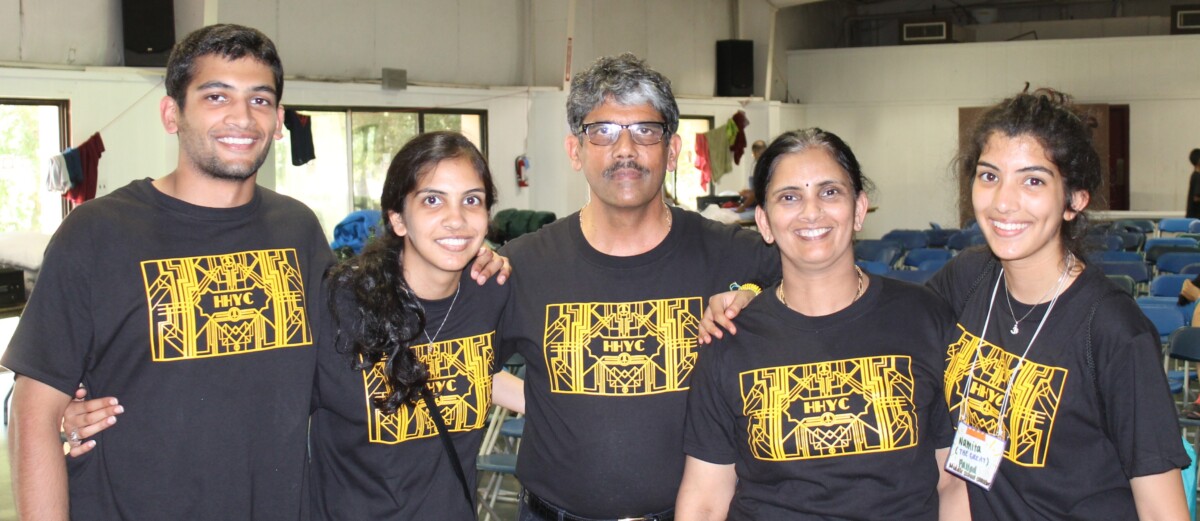
My name is Kavita Pallod Sekhsaria, and because I am a frequent target of Pieter Friedrich, I want to introduce myself before I explain why his framing of me and my family in his writing goes well beyond inaccuracy into something more deliberate: an effort to stigmatize and silence ordinary Hindu Americans like me.
I was born in 1988 to two Hindu American immigrants, Vijay and Sushma Pallod. They raised me with love, but they also raised me with expectations — not about status, but about service. I was probably five when they took me and my brother, then three, to volunteer at a clothing drive for victims of the earthquake in Latur, South India. My childhood is full of memories like that: serving, laughing, eating, learning, and being taught that community is something you build with your own hands.
Ramesh Bhutada, my father’s first cousin’s husband, and Jugal Malani, my father’s first cousin, were warm and steady presences in that childhood. Family trips to Olive Garden were as common as trips to the local mandir. I have often joked to friends that I had the weirdest Indian father of all: he told me perfect attendance was for losers, that grades did not measure my potential to give back to the world, and that he really hoped I would not become a doctor.
My father and my uncles lived the kind of life they hoped to inspire in me. They made time for their families. They made time to serve the Hindu community and the broader Houston community they felt deeply responsible to. They took pride in doing their work well. They also raised me to be critical — to interrogate what I believed, not inherit opinions unthinkingly, and to understand my duty in life through the lens of what would make the world better.
Ultimately I did become a doctor, instead of fulfilling my father’s dream that I become a journalist, but I am grateful to still have the ability to pick up my pen now and offer an actual picture of my family in contrast with the hateful one Friedrich has tried to construct.
In his recent piece on Rakhi Israni, a mother of four, non-profit attorney and educator, who’s running for CA 14’s Congressional seat, he opens with a line designed to make a Hindu youth camp, a family network, a congressional candidate, a federal filing, and a guilty plea feel like parts of a single dark revelation. The frame is clear: same network, same families, same surnames, same suspicion.
But that is exactly the problem with his work. He does not begin with proof of wrongdoing or follow the evidence where it leads. He begins with Hindu association itself — family ties, camp ties, religious ties, community ties — and invites readers to treat all of it as presumptively sinister.
Yes, we are connected. Yes, many of us know one another. Yes, families in the Hindu community serve together across generations. That is not a scandal. That is what community looks like.
The Hindu Heritage Youth Camp he gestures toward so ominously is not proved in his piece to be a site of indoctrination, hatred, or criminality. The publicly available anniversary booklet shows what most community institutions show: families volunteering, people serving, children growing into counselors and leaders, and a shared sense of cultural continuity. If Friedrich wants to claim that such a space produced something nefarious, then he should present actual evidence: testimony from campers, parents, counselors, or staff about specific teachings, specific harms, or specific acts. Instead, he offers only insinuation.
“Suspect, complicit, supremacist-adjacent, ideologically aligned, networked” — these are the terms and qualities Pieter invites his audience to project onto me, using my last name, my marriage, and my role as a Hindu Heritage Camp director as evidence, while offering no words or actions of mine that would actually justify that portrait. That is the method: flatten a person into her associations, and from there, tar everyone around her. One of his favorite targets is Aruna Miller, the lieutenant governor of Maryland, whom he has branded a “Hindu nationalist” through the same lazy logic of association, while barely grappling with her actual public record. It would, of course, be inconvenient for him to contend with my actual relationship with Aruna. The most meaningful conversation we’ve shared was the moment I tearfully gave her a knit Bernie Sanders doll and we reflected together on how deeply we both admired his moral clarity and the values he represents. An odd scene, I think, for two supposed puppets of the BJP government.
And as for Rakhi Israni: I’ve called her Rakhi Didi since the day I met her. She was and remains a kind, steady presence — someone who taught me to take pride in being Hindu and American at once. She was also the person who sat with me over meals at Hindu Heritage Camp when I struggled to find my footing socially, which is to say: no, my childhood was not spent being crowned the “Hindu nationalist princess” of a sinister “family project.”
We, the targets of Friedrich’s ire, are complicated people. We hold beliefs (politically, spiritually, socially) that many may agree with and others not— honestly, given how much we disagree with each other, that is inevitable. But we are genuinely invested in doing good, and no amount of ominous wordsmithing can erase that reality from the view of any fair-minded person who knows us or would like to know us.
That is precisely what Friedrich’s work cannot accommodate. He does not begin with people as they are and follow evidence where it leads. He begins with Hindu names, Hindu institutions, Hindu family ties, and long-standing community relationships, and invites readers to experience all of it as inherently suspicious.
A particular reason that his strategy of flattening the Hindu community is deeply problematic, is that this does not help identify extremists. It makes it harder. If every Hindu institution is suspect, then nothing is actually being analyzed. If every family network is treated as a pipeline, then no one has to do the harder work of distinguishing between ordinary religious life, cultural pride, conservative politics, diaspora networking, ugly prejudice, and actual extremism. Once you collapse all of that together, you are no longer naming a problem clearly — you are blurring it beyond recognition.
I can say that personally. Growing up in Houston, immersed in the Hindu community, I did hear Islamophobic things. I am not pretending otherwise. There were people who said vile, ignorant things. But what is striking is that the people who actually say those things are never the focus of Friedrich’s work. Instead, he consistently targets people who, in my experience, do far more to push back on that ugliness than anyone in his orbit ever can, in spite of what their tailored, self referential CVs would have you believe.
And I know that because I have seen it up close. Recently, some people in the community objected to IMAGH, the Indian Muslim Association of Greater Houston, having a picnic at the Texas Hindu Campsite, in spite of the fact that the group was happy to follow all of the campsite’s requests, namely, keeping the meal vegetarian. This small, but vocal bunch launched an ugly smear campaign, littering dozens of local WhatsApp groups attacking specifically Vijay Pallod, Rishi Bhutada, and Ramesh Bhutada for “allowing this to happen.” What was the Pallod-Bhutada response? A strong, unequivocal push back on this absurd display of sectarianism. That matters. It matters because it reveals something Friedrich simply does not understand: for all of his so called research and journalism, he has no real grasp of the actual moral and political dynamics inside Hindu communities. He writes as though the people he targets are the engines of extremism, when in reality they are often the very people holding the line against it — demanding our community do better.
That is why his framework fails. It cannot distinguish between actual extremism and ordinary collective life. It cannot distinguish between pride and supremacy. It cannot distinguish between family and conspiracy. And it cannot distinguish between the people amplifying ugliness and the people restraining it.
If Friedrich believes a person is dangerous, hateful, or extremist, he should show us. Quote them. Document the conduct. Speak to people who have worked with them, disagreed with them, learned from them, been harmed by them, or been helped by them. Show the public the actual evidence for the moral conclusions he wants them to draw. They are public figures, connected to hundreds of people at the least. It wouldn’t be hard. If such evidence exists, it should be presented plainly. Since such evidence does not exist, what remains is not serious journalism but stigma-by-network.
But too often, that is precisely what is missing. In piece after piece, association substitutes for proof. A donation becomes contamination. A family relationship becomes a clue. A Hindu institution becomes a pipeline. A public figure’s proximity to someone else becomes more important than their own record, their own words, and their own life.
In lieu of a real case, statements such as ‘a congressional staffer said xyz’ are presented. These quickly fall apart when one realizes that the sources offer no backing but are reliant on Friedrich’s flawed work to make their statements, in a self referential network bolstered by fringe organizations. That HAF hasn’t done any significant work on Capitol Hill since 2021, after shifting to state-based work, is an inconvenient truth and easy for Friedrich to ignore as he crafts his hateful narrative. The irony that Pieter can use Hindu surnames to lead readers to the conclusion that there’s a grand conspiracy, while using shell organizations to mask his own well funded and ideologically aligned network doesn’t escape me.
And this matters even more in the American context. If Friedrich wants to justify treating a broad swath of Hindu American community life as presumptively threatening, then he should be able to point to an actual demonstrated pattern in the United States that warrants that kind of fearmongering. But where is it? Major public overviews of terrorism and extremist violence in the United States emphasize other categories of threat, not “Hindu nationalist” violence as a distinct domestic terror threat. There are no arrests, there are no documented incidents, there is no pattern of a threat to American life from “Hindu Nationalism”. Plain and simple.
And if that sounds like too convenient a point, I would say the comparison should be obvious. In the United States, there have in fact been real acts of jihadist violence. And yet we rightly understand that Muslims cannot be treated as inherently suspect because of that. Civil liberties advocates have spent years arguing, correctly, that profiling, communal suspicion, and broad stigmatization are unjust and counterproductive. The ACLU has made exactly that case in response to anti-Muslim discrimination and suspicion, and research on jihadist terrorism in the United States itself has warned against treating an entire community as the problem. It is not just wrong, it is ineffective. The way to fight extremism is to equip those within the community to do the work. Pieter’s work does the opposite.
So then, what exactly is the justification for Friedrich’s method when it comes to Hindus? If there is no demonstrated pattern of “Hindu nationalist” violence in the United States that would justify treating ordinary Hindu Americans as a presumptive public threat, then what remains is not prudence. It is prejudice dressed up as analysis.
That is why this matters beyond one article. Friedrich presents himself as a progressive champion of democracy targeting “Hindu nationalism”. But his method sweeps far wider. It tells readers that if Hindus organize, if Hindus fundraise, if Hindus build institutions, if Hindus remain close to family, if Hindus take pride in their heritage, all of that is fair ground for suspicion. The problem is no longer a specific ideology proven through words or deeds. The problem becomes Hindu life itself and the realization that there is little if any difference between Pieter Friedrich and a white Christian nationalist.
Say it plainly: when every Hindu camp becomes suspect, every Hindu network becomes sinister, every Hindu donor becomes contaminated, every Hindu family connection becomes political evidence, and every expression of Hindu pride becomes grounds for moral suspicion, this is no longer a narrow critique of an ideology. It is a broader attempt to make Hindu identity itself radioactive in public life.
That is why so many of us reject Friedrich’s project. Not because we oppose scrutiny. Not because we think powerful people should be beyond criticism. But because criticism without standards becomes propaganda, and propaganda built on association becomes prejudice.
My own family should make that obvious. We are not a hive mind. We do not vote the same. We do not think the same. We argue. We disagree. We make fun of each other’s politics. Some of us are progressive. Some are conservative. Some are politically confused, politically inconsistent, or politically exhausted. What binds us is not obedience to a foreign government or some secret ideological script. It is family. It is community. It is a religious and cultural inheritance that taught us service, obligation, and connection.
If journalists are genuinely curious, let them come meet us. Let them ask hard questions. Let them examine actual beliefs, actual conduct, actual institutions, and actual differences among us. But let them also interrogate the lazy premise at the heart of Friedrich’s work: that being related, being Hindu, serving together, or taking pride in one’s faith is enough to turn ordinary people into evidence.
It is not.
And no amount of ominous prose can make it so.