

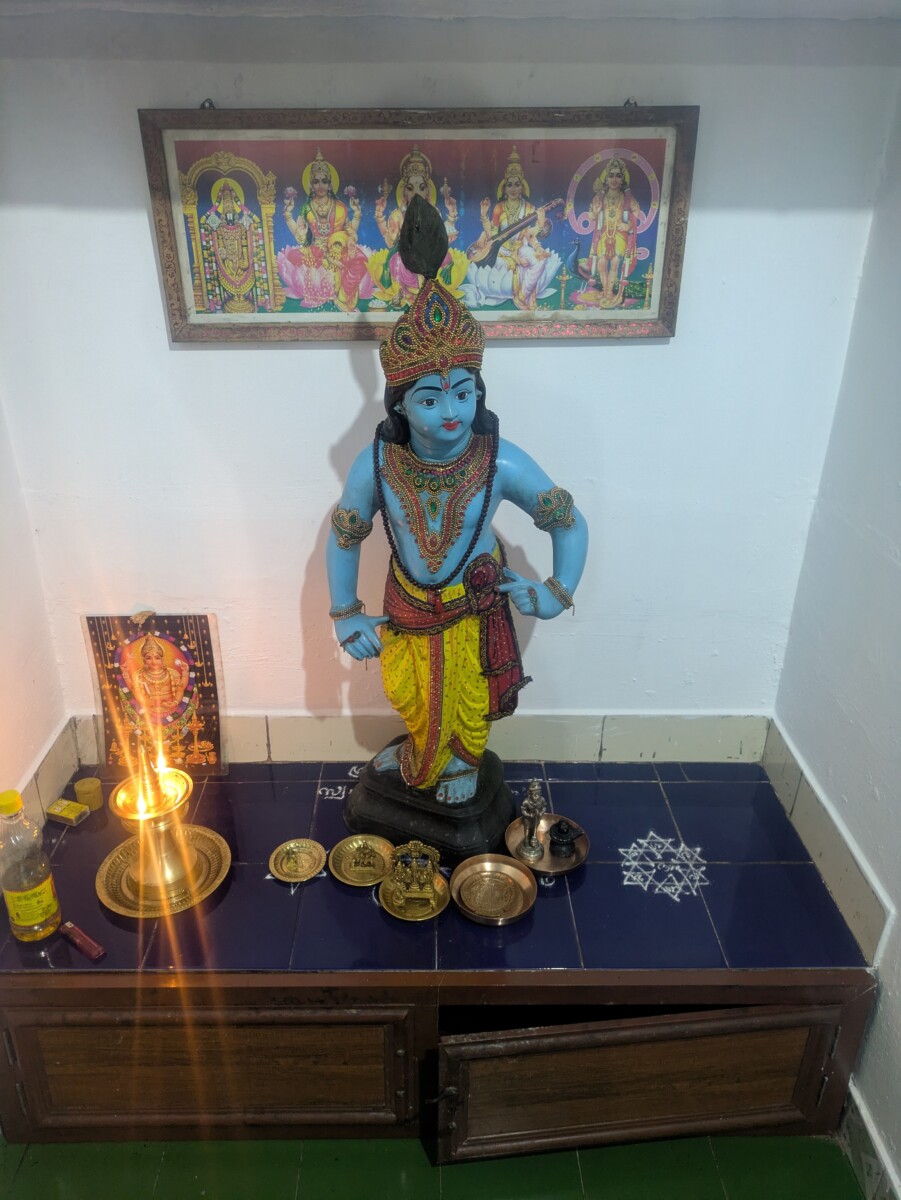
Travel memoirs of visiting one’s ancestral home in God’s Own Country
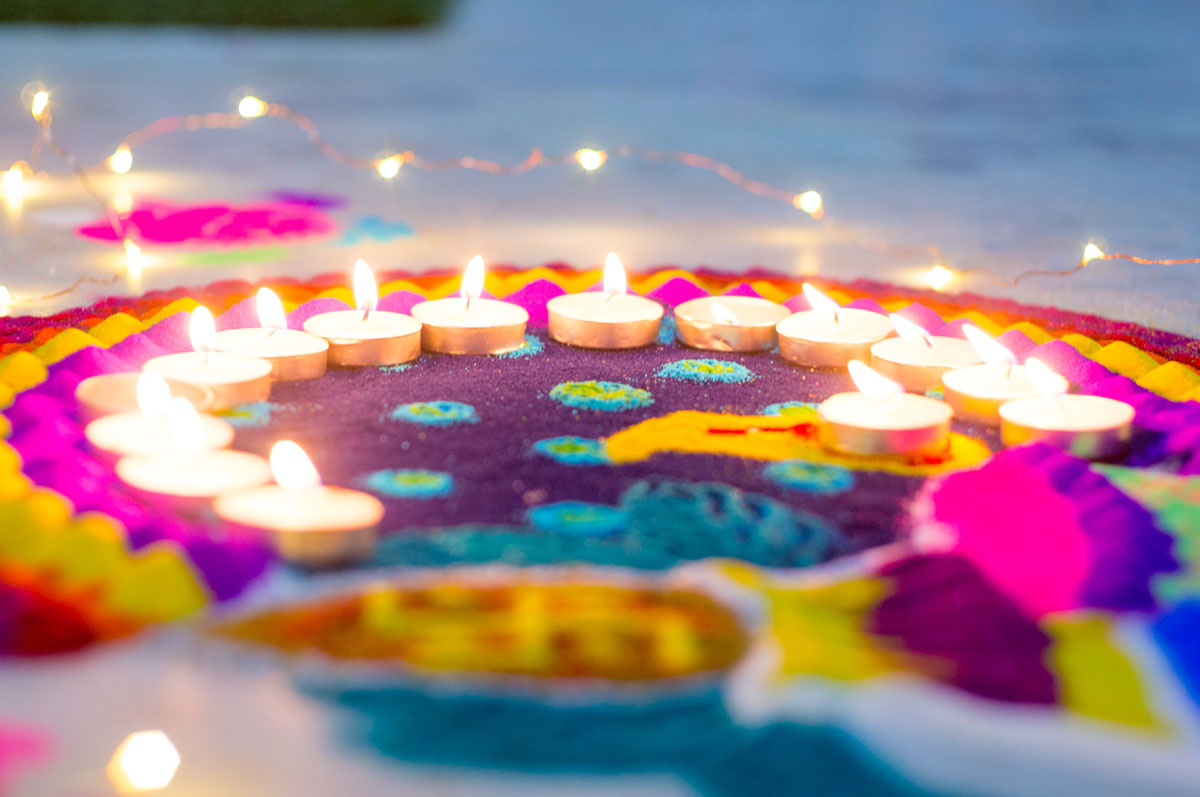
Onam Ashamsakal – “Happy Onam”!
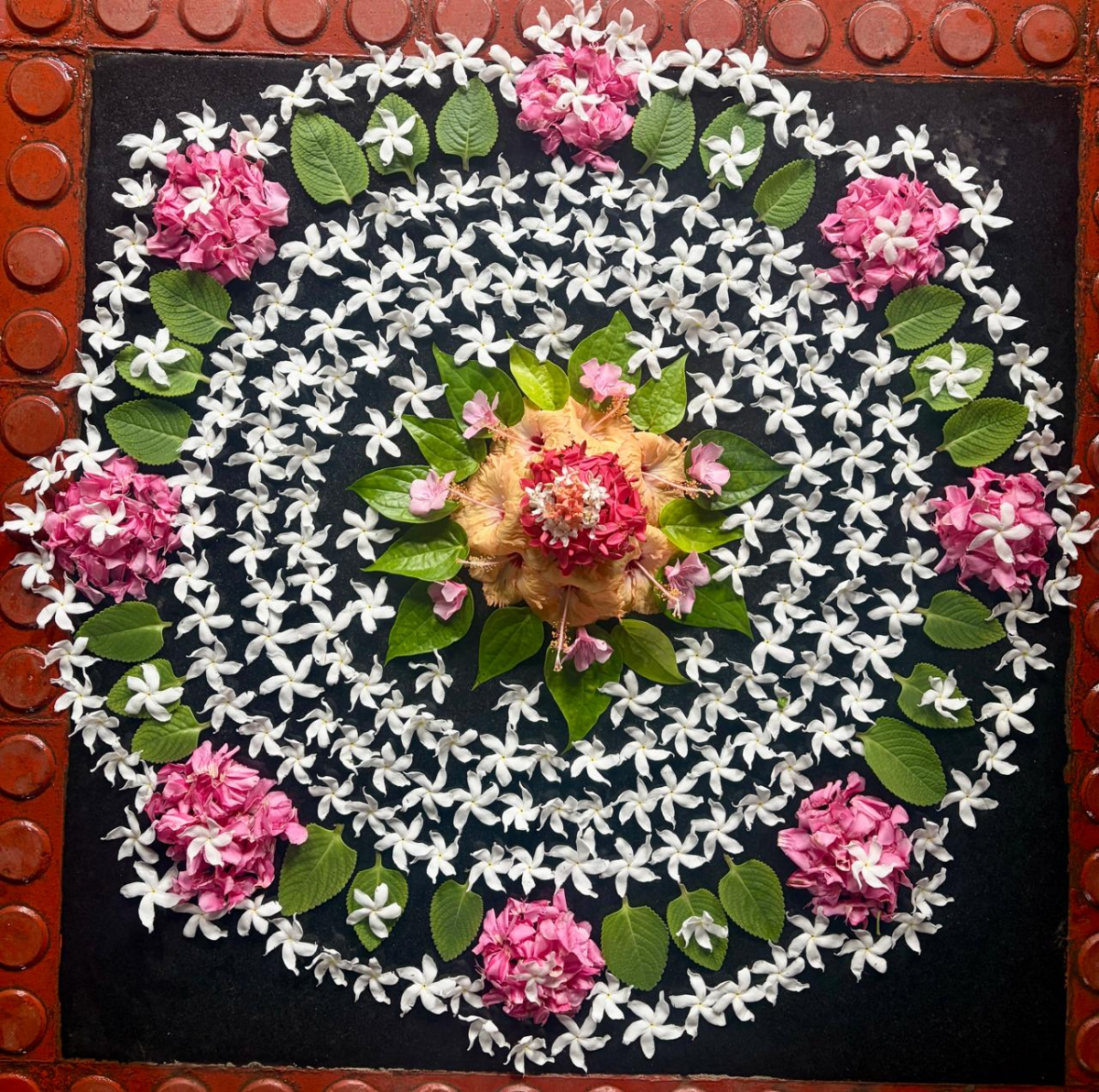
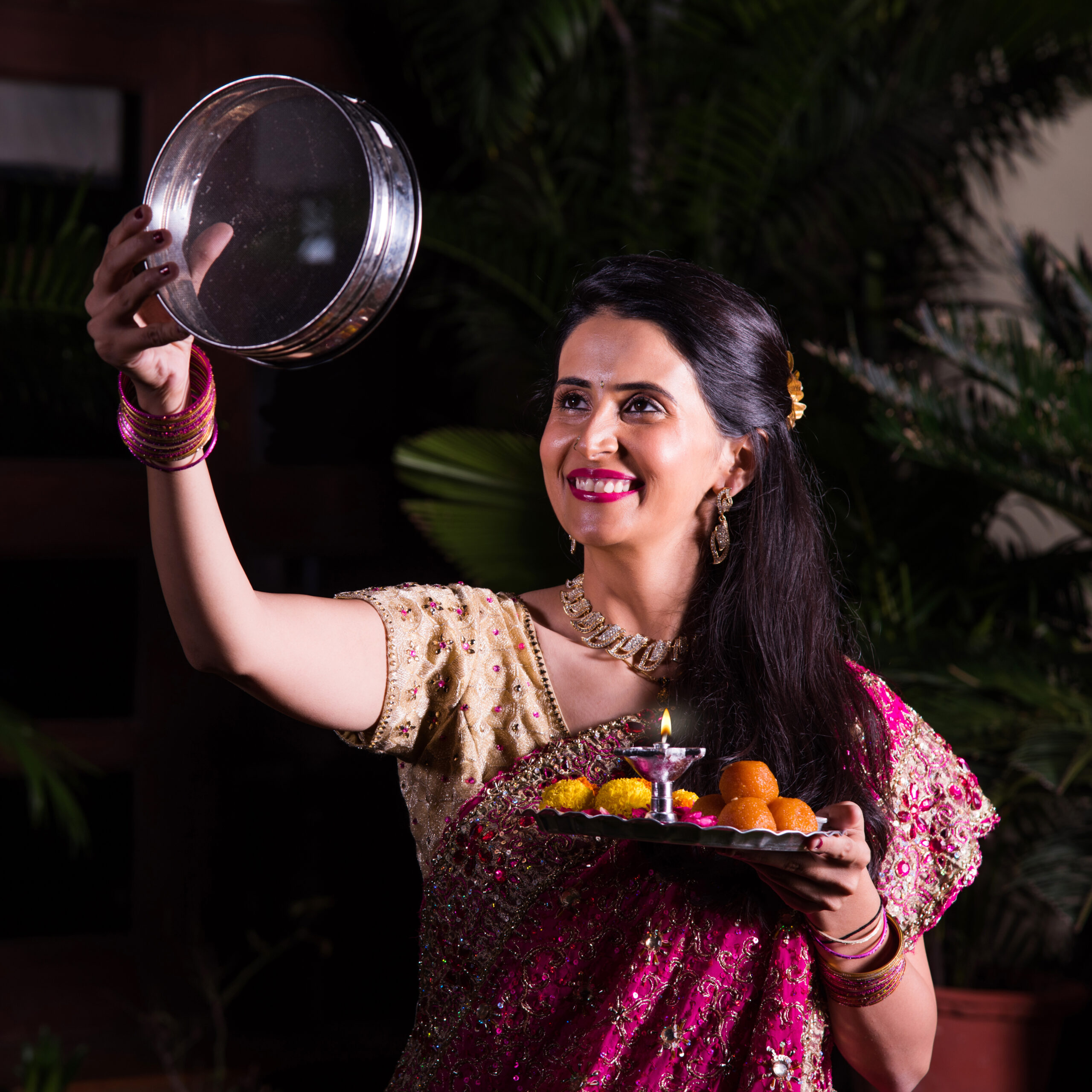
Caption: Pookalam design by Meenakshi Praveen- photo by Praveen Krishnan
Kerala is a top destination for tourists from across the world. But for my family, Kerala is home. And visiting home means returning to one’s roots, experiencing history, and living Hindu culture like no other. In the past two weeks since Onam started, my SM feeds and WhatsApp posts have been filled with pookalam designs, videos of boat races, sadhya ( feast in Malayalam) menu ideas, and everything Kerala. Hence, this article reminisces about our recent visit to our ancestral home this past summer.
Day One: Adi Shankara, Aruvamanai and Abhyangum
So, what do you do when visiting your ancestral home in Ernakulam district, Kerala? You start by refreshing your water-drawing skills from a well, followed by a delicious, made-from-scratch Keralite breakfast of idiappam, vegetable ishtu made in coconut milk, and raw mango chutney. You set new fitness goals when watching the women bend 100% effortlessly when prepping food for 20+ mins! More bends for sure!!
Next, you visit the local stunningly beautiful Vadakunaathan temple, dedicated to Shiva. Walking barefoot on the cobbled paths gives much-needed grounding and refreshes the lost skill of walking barefoot for extended periods. You learn that it’s common practice among the locals to start their day with multiple pradakshinas, and a darshan of the deities within. How wonderful is it when devotion leads to fitness, as achieved by the many Hindu practices involving temple visits? While visiting the various sannidhanams, you stare indefinitely at the samadhi of none other than Adi Shankaracharya himself. And remind yourself that you are in the motherland of the Master of Advaita Vedanta and one of the greatest rishis of all times! It’s one of those moments that give you goosebumps for sure!!
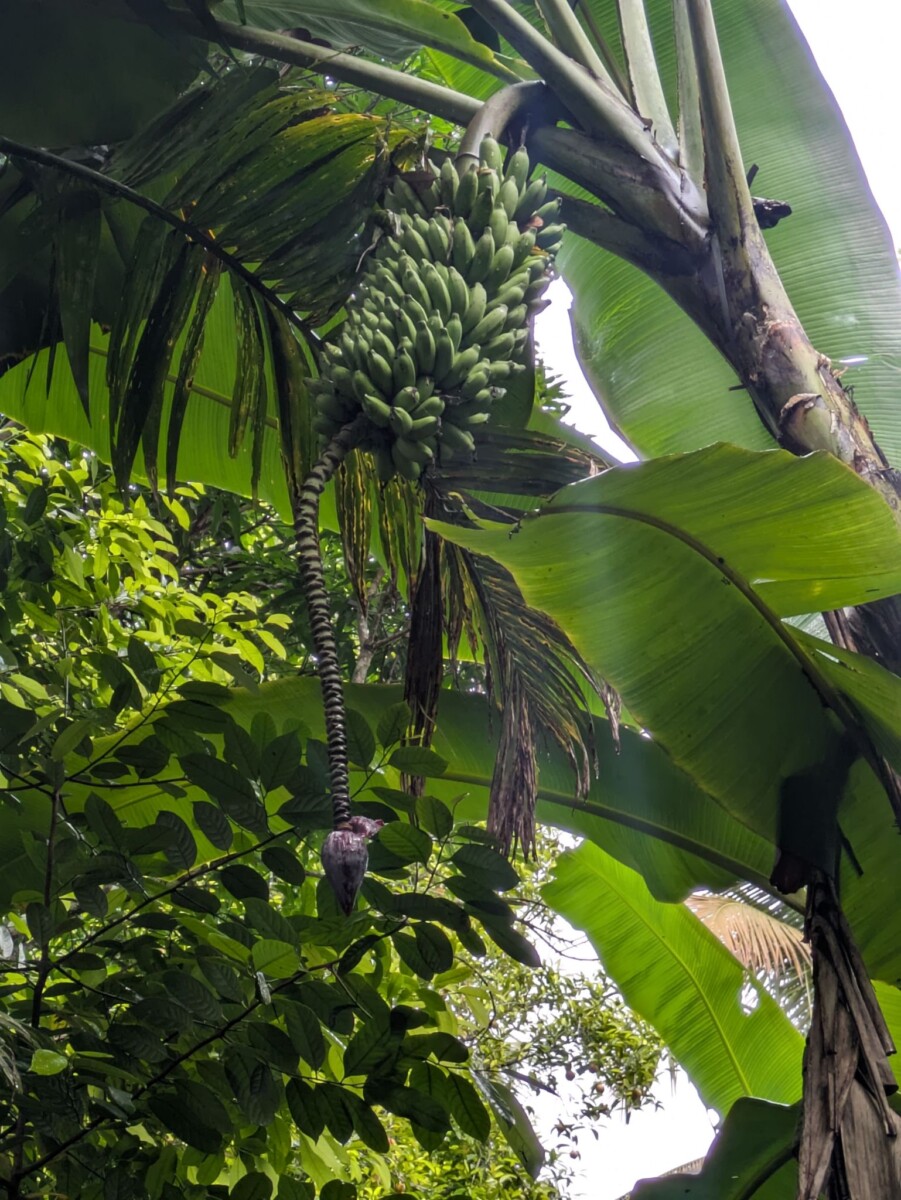
Caption- Banana tree in a Kerala backyard- photo by Sangeetha Shankar
Once back home, you get pulled into what most Kerala homes are stressing about in the monsoon month of July! How to consume the next giant jackfruit that’s been harvested from the backyard? You get curious about the jackfruit tree and get a refresher course on identifying the plethora of plants in the backyard- including fruits like mangoes, guavas, sapotas, papayas, multiple varieties of coconuts, bananas, vegetables like moringa, eggplant, okra, green chilies, various types of spinach, and spices like bay leaf, pepper, cinnamon, to name a few. The monsoons lash incessantly when you do so, and you realize what a blessed land India is with its incredible, unparalleled diversity of flora and fauna.
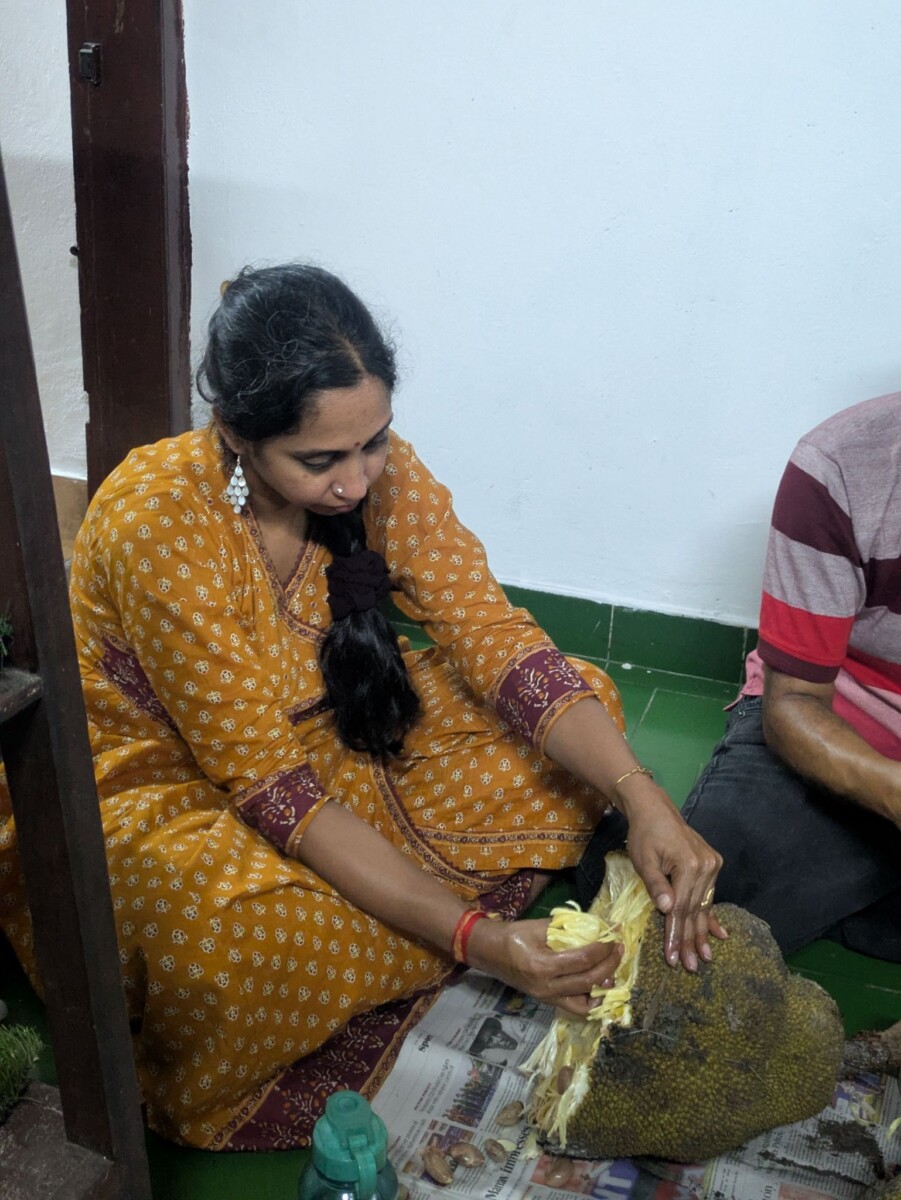
Caption: Removing jackfruit from its shell- Photo by Shreedhari Shankar
Along with the rains, you also get freaked out at the sight of two mongooses fighting and rush indoors! Phew!! Once home, along with the jackfruit that’s been harvested, you get drawn into the age-old ritual of opening a giant jackfruit to get the fruit inside and separate its seeds. Yet another exercise in seamless back-bending and a refresher course in using an Aruvaamanai (Tamizh for an ancient Indian household cutting tool). Well, that reminds you how much more leg and core strength you need to work on at your fancy gym back home in the States to use an everyday Indian indigenous tool! You dab your hands with coconut oil, pull out the jackfruit pieces one by one with patience, and realize what a heck of a sticky fruit it is. The consumption of unique snacks like jackfruit chips, jackfruit jam,and jackfruit kheer accompanies this icky, sticky business! Well, in a Hindu home, one doesn’t need to wait until dinner to enjoy a dessert. Sweet and savory are part and parcel of everyday life, as reflected in a typical Hindu meal featuring both. The jackfruit has been extracted from its giant shell, but the tool that aided its release needs to be restored to its original glory, which means removing the stickiness from the blade. Curiosity begets you in the kitchen, and you watch the women burn the Aruvaamanai in a flame! So much for enjoying the jackfruit! Well, the fruit certainly has all of Kerala wrapped around its massive poky skin!!
After all that jackfruit, you head to an Ayurvedashram to get an abhyangum and feel helpless on a slippery table as you are massaged with tons of medicated oil by two pairs of trained hands. Kerala is the South Indian capital of all things Ayurvedic! So, why not?
Day Two: Temples, Turmeric and Tamizh
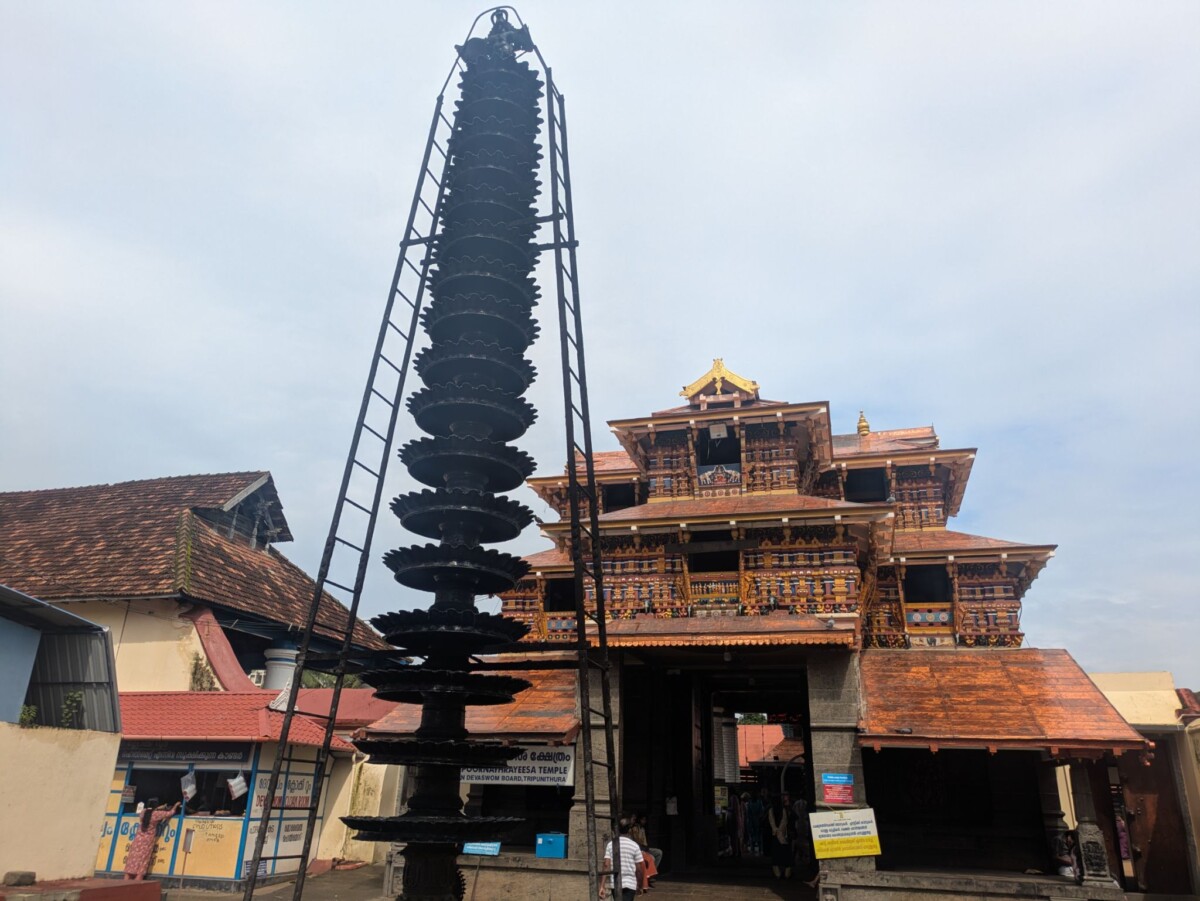
Caption- Poornathrayeesha Temple, Thripunitura- photo by Sangeetha Shankar
The next day, you visit the local Poornathrayeesha temple dedicated to Vishnu—this is the temple where one of the Panch Pandavs, Arjun, lit three lamps while venerating Vishnu with oil he pressed from seeds. These lamps, known as Kedu Vilakku, are kept ever-burning 24/7. The Kochi royalty also revered the temple, and during your pradakshina, you will get a glimpse of the royal quarters used by the royal family during their visits to the temple.
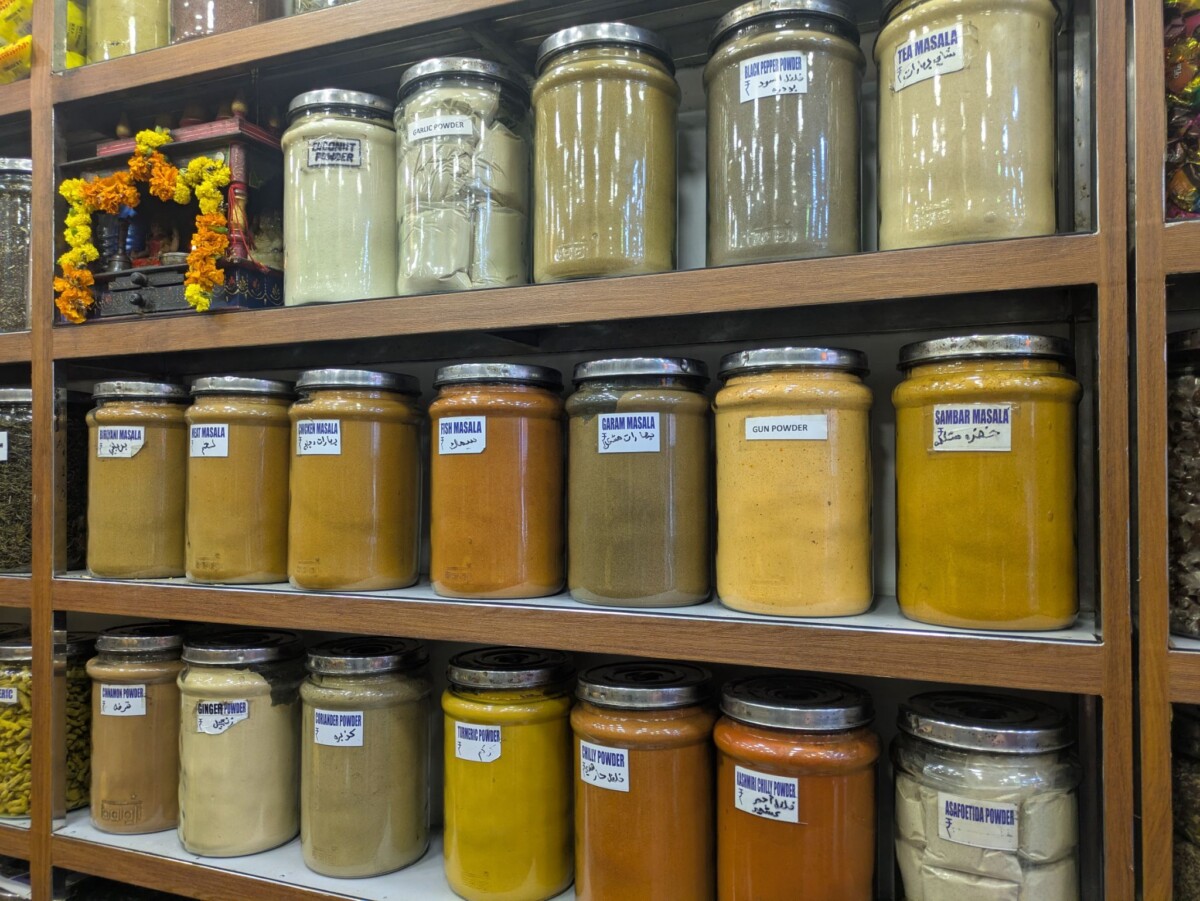
Caption- Bottles of spices in a spice shop in Ernakkulam- photo by Sangeetha Shankar
Then, you head to the local market in Ernakulam city and buy very fresh organic spices, as Kerala is the largest producer of spices in India. As you stare at the bottles of cloves, star anise, turmeric and pepper powder, you also realize the stellar linguistic power of the Gujarati salesman who switches between Gujarati, Malayalam, Tamizh and Sindhi at lightning speed! Well, the original polyglots are in India, and they aren’t even aware of it? Finally, you leave the spice shop, realizing yet again that the bananas, mangoes, jackfruit, and the plethora of spices got us into trouble in the first place with the British, Portuguese, and French, who truly needed to spice up their lives!
And then you come home to get into a very interesting discussion on how Malayalam and present-day Palghat Tamizh ( a mix of Tamizh and Malayalam ) have a heavy influence of Portuguese words in them, thanks to Vasco da Gama, the first European to ever land on the Indian shore of Malabar, Kerala, six centuries ago. Haha! It’s a small world after all!
And then it strikes you! Whether it’s Vasco Da Gama or the stream of foreigners and invaders who came after him, none managed to truly conquer the vast land of Bharat and its indigenous Hindu dharmas, for in its pluralistic mindset, it always adopts but never self-annihilates!
Aaaaand….you wonder – “Are Hindus EVER conquerable?”
Day Three: Family Deity, FIFA and Farwell
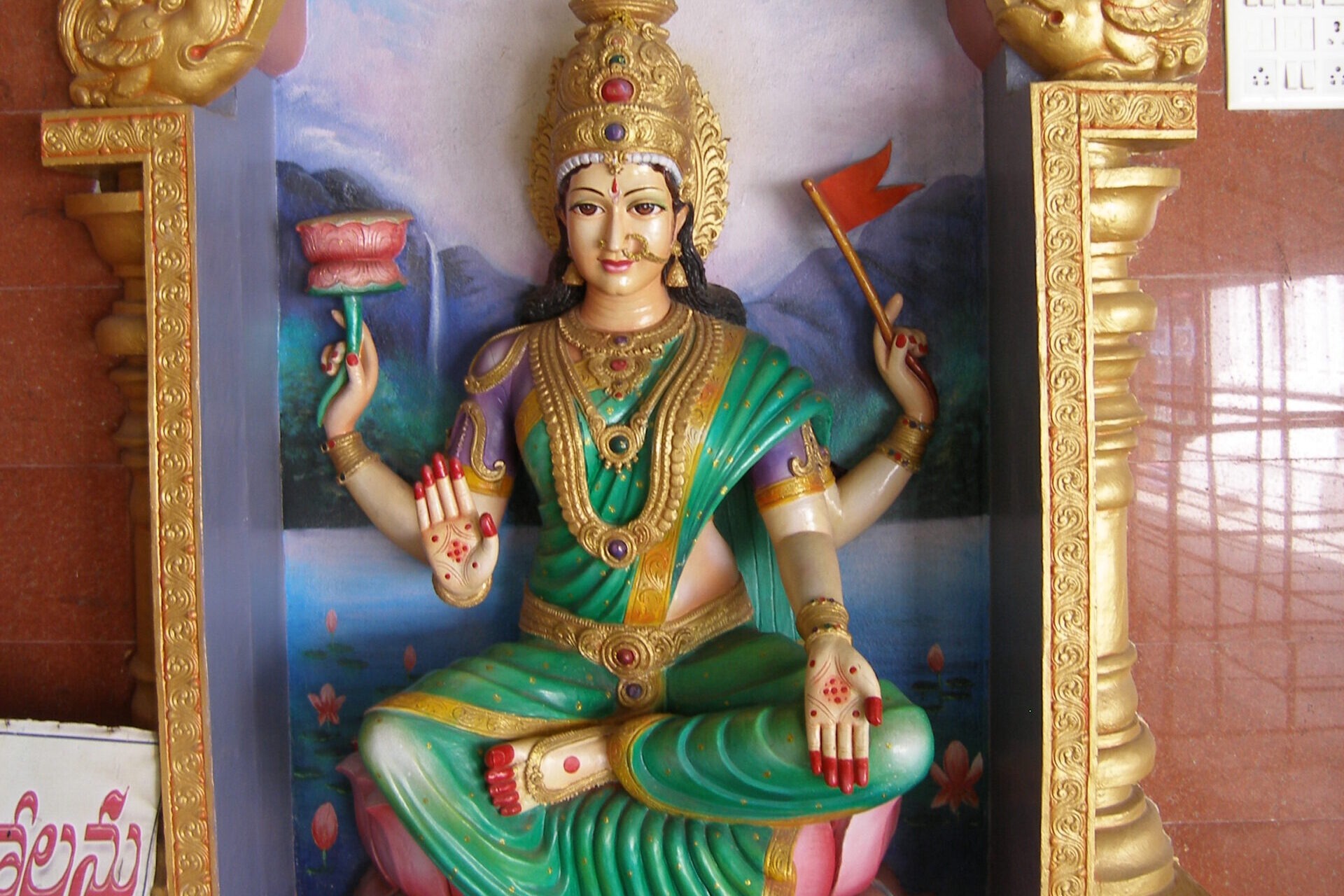
It’s the last day of your stay in Kerala and how can you leave without visiting your Kula Devi or Family Guardian temple? We head early in the morning to a small village called Thirukkur, near Thrissur, to attend the puja and aarti for our Kula Devi, Bhuvaneshwari Amman, a form of Mahalakshmi. She is housed in a devotee’s home, and as you drive through the village, you hear cries of gorgeous peacocks, flying from one coconut tree to another! You are stunned by how common these sightings are, and yet again remind yourself of the stunning beauty of the tropical land that India is!
You attend the Kula Devi puja with all reverence, thanking the devotee and all your ancestors for the traditions and knowledge passed down through the generations. Who would we truly be without these divine affiliations and collective identities? How amazing is it that even today, specific knowledge systems of veneration exist across India, unbroken by modern times? The Hindu dharmas are truly eternal, here to stay for now and forever.
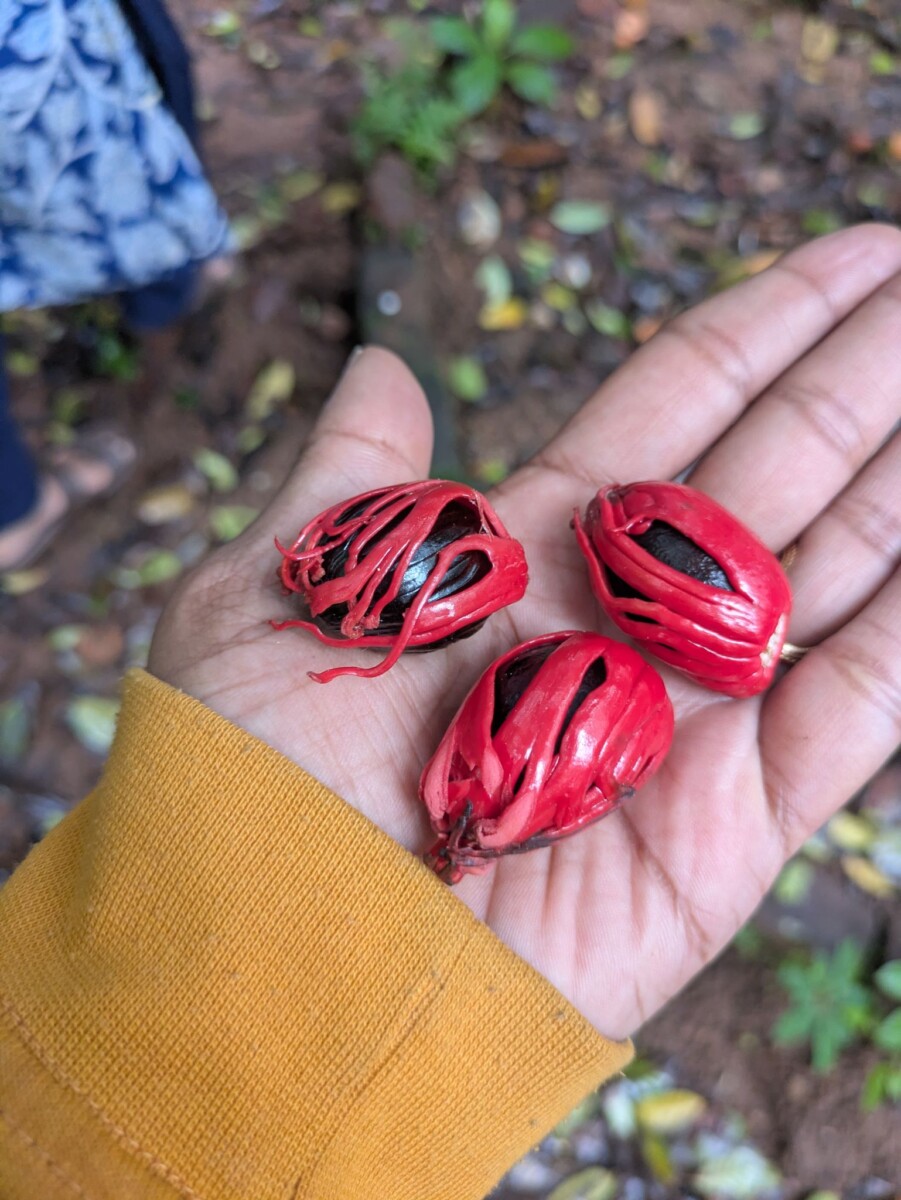
Caption- Nutmeg seeds in a Kerala backyard- photo by Sangeetha Shankar
After the pooja, you head to the devotee’s backyard, a sprawling few acres of tropical growth. You gaze in utter amazement at the massive teak wood, betel nut, and nutmeg trees. This backyard in particular produces kilos of nutmeg, enough to be sold at the market! Also, an interesting fact about teak trees: they have a unique coppicing ability and strong regenerative properties. When a tree is cut down to the stump, dormant buds near the base can activate and sprout new shoots. And this regenerative property symbolizes strength, longevity, stability, and auspiciousness, making teak wood purely sattvic and preferred in Vastu Shastra. Thus, it’s commonly used to build home and communal mandirs, in Gurba Grihas and sacred pillars. Well, it’s never too late for botany lessons! But more so, for the Hindu in me, it’s an apt reminder of how environment-friendly the Hindu Dharmas are. The wood used to make our revered mandirs is regenerative, symbolizing that the Hindu dharmas never encourage religious practices at the cost of nature’s annihilation!
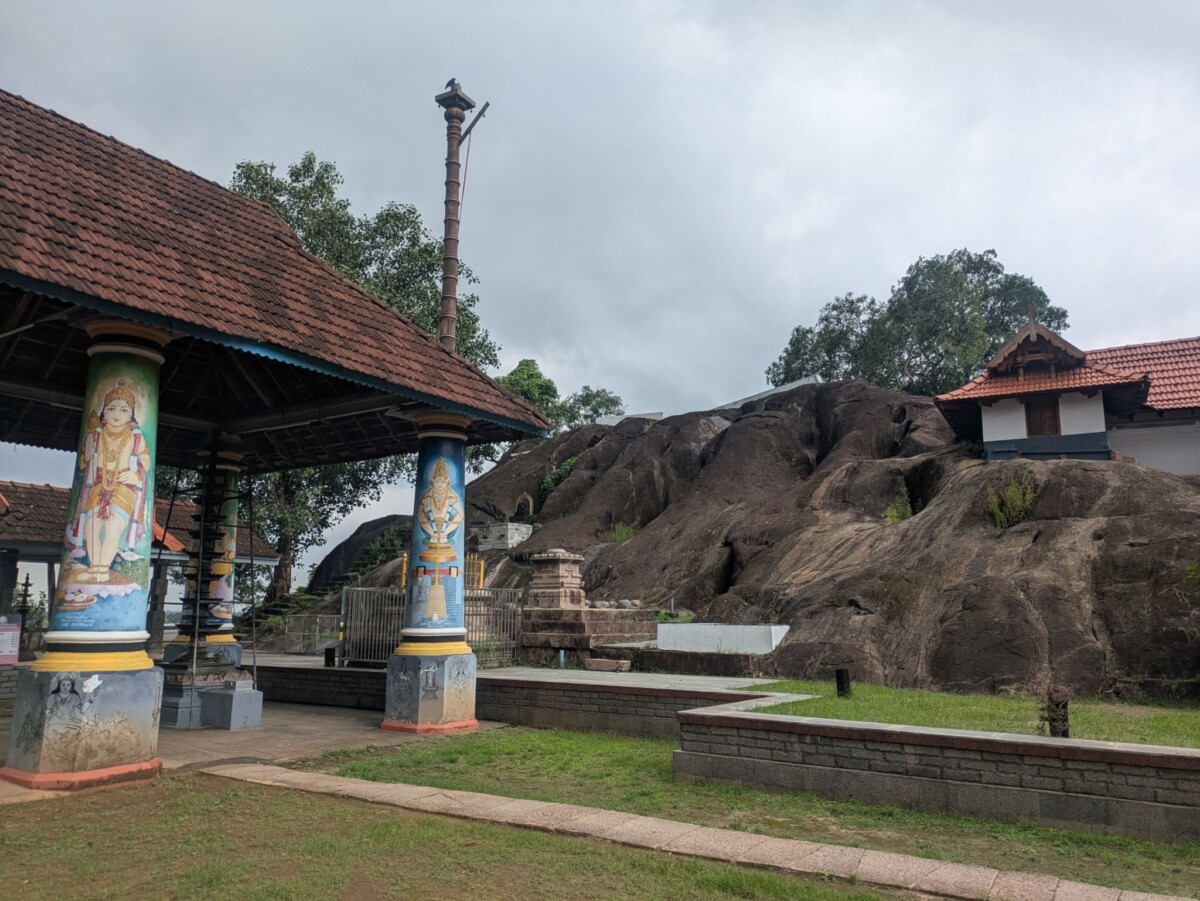
Caption- Thirukkur Mahadev Temple, Thirukkur- photo by Sangeetha Shankar
As we bid farewell to the devotee’s family, we are encouraged to visit the ancient village cave temple of Thirukkur Mahadeva. The word Thirukkur derives its name from Tamizh: Thiru means revered or holy, and Oru means village, town, or settlement. The temple was mesmerizing! The main Gurba Griha or Inner Sanctum, housing a majestic six-foot-tall Shiva Lingam, is entirely carved within a 30-foot-long cave. As you enter the cave’s dark interior, you hear devotees fervently chanting Om Namah Shivaya, which immediately puts you in a meditative state. No wonder that the cave temple was home to Buddhist, Jain, and Hindu monks and is considered one of the 108 notable Shiva temples. As you do the pradakshina around the temple, you also get lost in the views of the village and its surrounding forest below, growing in and around the Manali river. The entire divine experience was a reminder that divinity can be found when we choose to acknowledge the dark corners within us without judgment, and that nature and divinity are one. A forest can be the best temple ever, and its preservation the greatest service of all!
Next, you head to the Kochi airport for your flight out and see FIFA billboards with local teams expressing their allegiance to Argentina and Messi! Well, we believe in Vasudaiva Kutumbam, which means we are all one large divine family! So what’s stopping a small village like Thirukkur from rooting for their Argentinian brothers?
And yes! One last surprise! At the gate, I stumbled across none other than Padma Bushan and Sangeetha Natak Akademi awardee, Bharatanatyam and Kuchipudi dancer and actress Mallika Sarabhai. She is the Chancellor of Kerala Kalamandalam, a deemed university for art and culture in Thrissur district, and was flying out to her home in Gujarat. The Bharatnatyam dancer in me was overjoyed! All my childhood memories of watching her extremely graceful Kuchipudi dance in the national unity song “ Bhaje Sargam Har Taraf Se“ came flooding back to me! Oh my!
This Kerala trip truly was a return to everything home and one’s roots! God’s Own Country never disappoints!
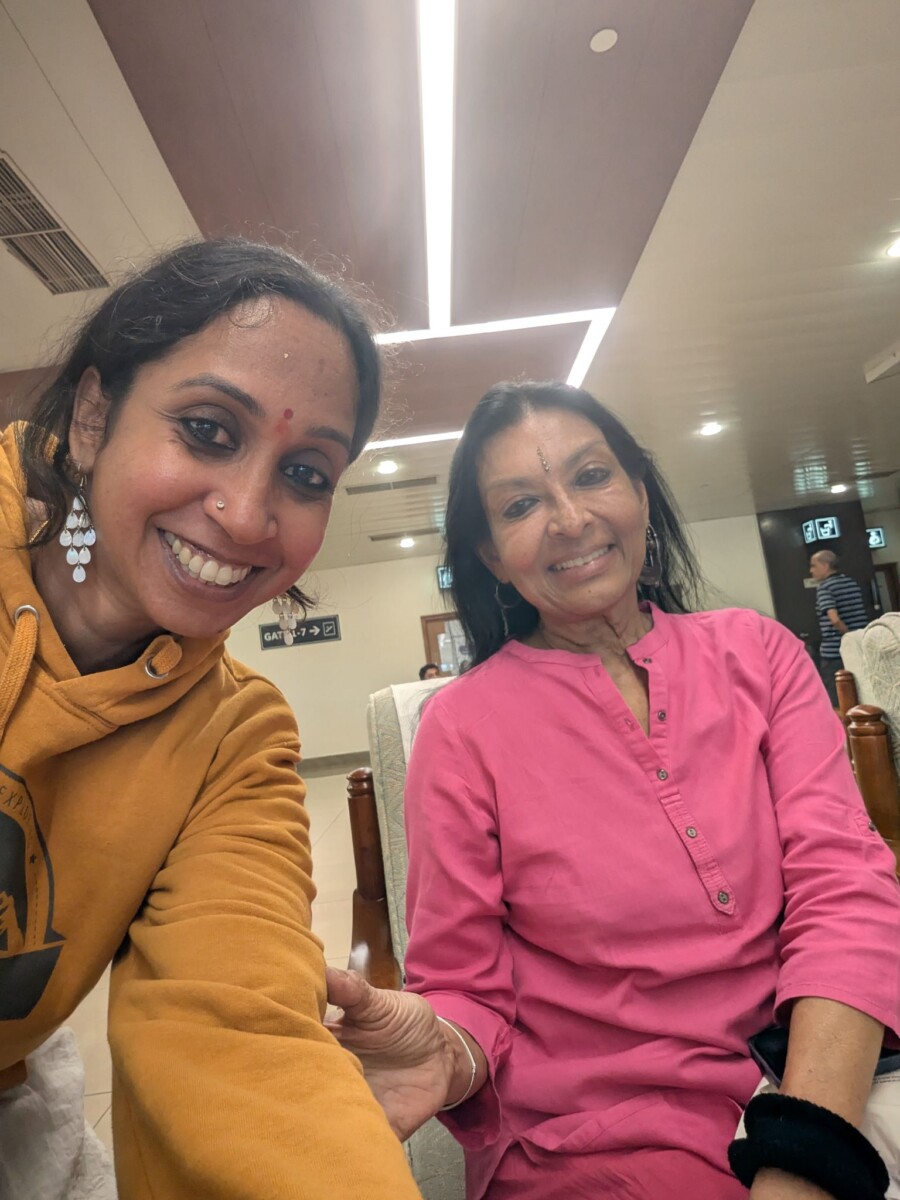
Caption- With Mallika Sarabhai in Kochi airport, Kerala- photo by Sangeetha Shankar