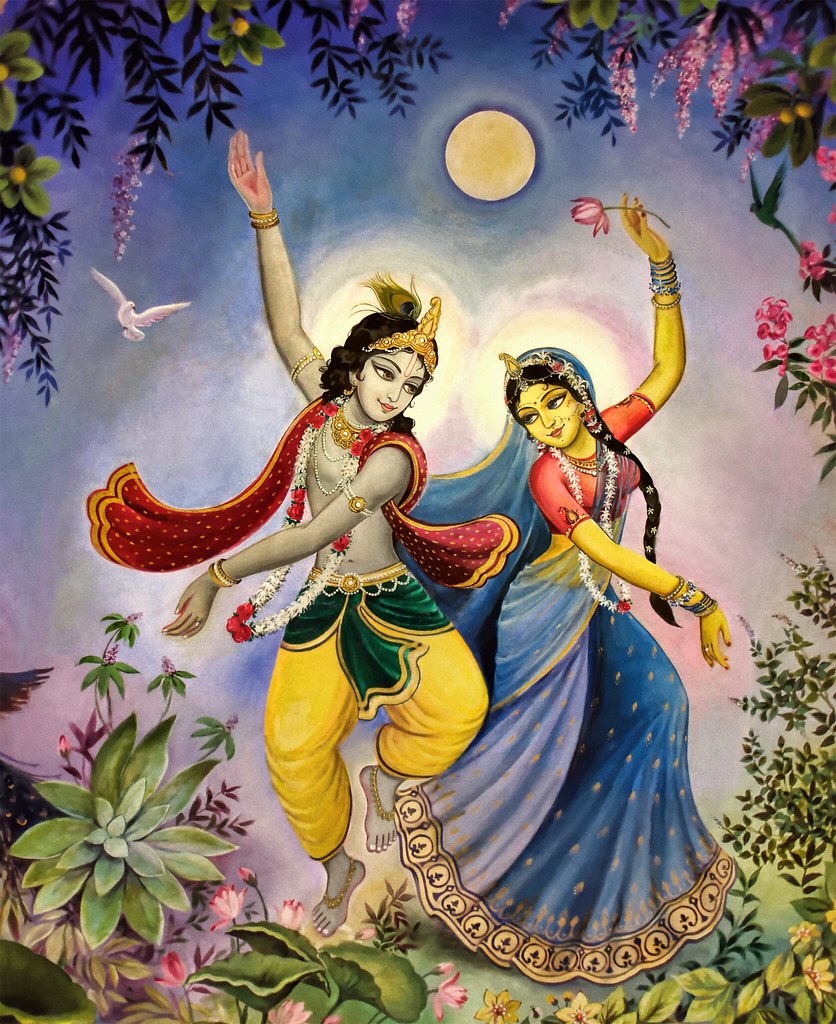


There are several legends associated with the celebration of Holi, popular in various Hindu communities.
 Story 1: The Tale of Prahlāda and Holikā
In the age of the great empires, there lived a King named Hiraṇyakaśipu whose power was surpassed only by his arrogance. He believed he had cheated death itself, having secured a boon that rendered him nearly invincible. With the world at his feet, he demanded a singular tax from his subjects: their total, undivided veneration. To Hiraṇyakaśipu, he was better than even the Supreme Being.
But within the bejeweled halls of his own palace, a quiet rebel roamed. His young son, Prahlāda, refused to bow. While the King demanded the world chant his name, Prahlāda’s lips moved only to the silent rhythm of devotion to Viṣṇu. To Hiraṇyakaśipu, this wasn’t just a difference of opinion; it was an existential threat. A father’s love quickly curdled into a blinding, murderous rage. If the boy would not serve the King, he would not live.
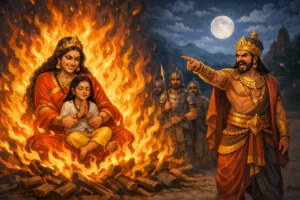
As the popular tales go, at this point, after several failed attempts to kill the boy, the King’s sister, Holikā, emerged from the shadows with a sadistic smile. She possessed a gift—an immunity to fire that made her as dangerous as she was loyal. “I will take the child into the pyre,” she suggested. “I shall survive the flames, and he will be consumed by them.”
The bonfire was a towering mountain of wood and biofuel. Holikā clutched Prahlāda, dragging him into the heart of the roaring inferno. She sat with the boy in her lap, waiting for the inevitable.
Instead, there was a wonder to behold. The Hindu sources of knowledge teach that intentions are the true wielders of power. Because Holikā had weaponized her gift to destroy an innocent life, her protection vanished like smoke. The flames, once her servants, became her executioners. In the center of the pyre, Prahlāda remained in a state of deep, meditative refuge. To him, the fire was not a threat; it was merely the background noise to his unwavering peace. When the wood turned to ash, Holikā was gone, but the boy stepped out of the embers, untouched and serene.
Why This Story Matters Today
The tale of Prahlāda and Holikā serves as a psychological blueprint for the modern world. Hiraṇyakaśipu represents the Toxic Ego, the “trap” of believing that one is perfect, which inevitably leads to destruction – even of those we love. Prahlāda, meanwhile, is the archetype of dedicated, singlepointed devotion (which can also manifest as defiance). He proves that integrity can achieve a transformation that trying to physically remove his father never could – as he was not powerful enough to match or overpower him, showing us that our universal values are non-negotiable, regardless of the pressure to conform, but that defiance has to be aware of the contexts. Can we achieve change, or are we engaging in performative defiance, or righteous indignation which is really another fuel for the ego. Real change comes about through a thorough assessment of the possibilities and working for both short term and longer term, systemic transformation and improvement – not to stroke one’s own ego, but selflessly and humbly for the benefit of others.
On another level, it is a story of resilience against abuse. For a child in a chaotic environment, meditation, grounding, and devotion can become an “inner refuge”—a spiritual and emotional safe space. Moreover, for the monotheist Hindu Dharmas, it represents the power of devotion, and maintaining the internal connection with Bhagavān. Finally, Holikā’s fate is a stark warning against the weaponization of privilege. When we use our unique talents or social advantages to marginalize others, we risk the very “boons” that granted us our status in the first place.
How to Celebrate Holikā Dahana
Every year, on the full moon of the lunar month Phālguna, a bonfire is lit once more. This isn’t just a reenactment; it is a cleansing. On Vasanta Pañcamī, the first wooden stake is planted into the ground, and for the ensuing ~40 days, people collect the chaff from the springtime harvest, biofuel, and any dry branches around it. On the night of the full moon of Phālguna, known as Holikā Pūrṇimā, pūjā is performed, and the bonfire is lit.
As the fire brightens, the community circles it (safely) with mantras and song. They aren’t just burning wood; they are burning the negative tendencies that reside in our minds and hearts. By incinerating the memory of Holikā, they clear the path for a new season of growth and humble, steadfast living.
Story 2: Kāmadahana
The Tale of Kāmadahana
High in the frozen reaches of the Himalayas, Śiva, the Supreme Being, sat in an unmoving trance of ascetic practice. To the world, he was a statue of ice and ash; but to the devas, the illumined beings charged with the protection of the universe, his asceticism was a problem. The universe faced calamities that required a child born from the union between Śiva and Pārvatī, the embodiment of Śakti. But, Śiva remained entirely detached, his mind absorbed in samādhi.
The devas decided to force his hand. They summoned Kāmadeva—the personification of desire, equipped with a bow of sugarcane and five flower-tipped arrows—to strike the Supreme Yogī with a sudden, overwhelming infatuation.
The Error
Kāma approached Śiva, his pride bolstered by his past successes. He believed his power over the heart was absolute. As he drew his bowstring, aiming for the silent heart of the Great Being, he didn’t realize that Śiva, the Supreme Being, knew everything. He also knew that a lesson needed to be learned, that even in dire circumstances, no one should force or manipulate someone without their informed consent. So, Śiva resolved to teach the devas a lesson that would reverberate through the ages.
As the arrow flew, Śiva’s third eye—the eye of spiritual insight—snapped open. It was not just a weapon of fire; it was the manifestation of pure, unadulterated realization. In a blinding flash of cosmic anger, Śiva incinerated Kāmadeva’s physical form. In an instant, the colorful deva of love was reduced to a pile of gray ash. Because of this, he became known as Anaṅga, the bodiless one.
Love, Reformed
However, this was not an act of cruelty. As the Śiva Purāṇa records, this destruction was a necessary humbling—a “hard reset” of the ego. Once Kāma’s physical bravado was burned away, Śiva’s anger dissolved into a nectarine glance of compassion.
With a single look, Śiva revived Kāma from the ashes, granting him a “comely, wonder-inspiring body” that was more splendid than before. But there was a difference: Kāma now was a devotee of Śiva, part of his own entourage. He was no longer a rogue force of blind impulse; he was now integrated into a higher, spiritual grounding, enjoying the bliss of realization.
Why This Story Matters Today
For the modern reader, the Kāmadahana offers a sophisticated critique of how we perceive love and attraction:
- The Limerence Trap: The story warns against the danger of limerence—that temporary, obsessive state of “love at first sight” based solely on external aesthetics, or job, status, wealth, power etc. By burning Kāma, Śiva demonstrates that attraction focused only on the body is a fool’s errand that ultimately leads to spiritual and emotional destruction.
- The Supreme Being vs. The Ego: Kāma’s attempt to get the better of Śiva represents the human ego’s belief that it can manipulate the natural order through bravado. Śiva’s reaction shows that true power (śakti) always subdues temporary impulses (kāma). It also demonstrates that love is not possible where the partners are not willing. Consent should never be overlooked, especially in matters of pleasure and enjoyment.
- Authenticity Over Appearance: Soon after this event, Śiva and Pārvatī did indeed marry. However, their union was not the result of a magical arrow or a physical spark. It was the result of a gradually formed, deeply authentic connection based on Pārvatī’s intense spiritual discipline and Śiva’s recognition of her essential nature as Śakti.
- Transmutation, Not Suppression: Crucially, Śiva did not delete desire from the universe; he rendered it bodiless and then restored it. This teaches that we shouldn’t merely “suppress” our desires, but rather “burn away” their shallow, body-centric, obsessive qualities so they can be reborn as something spiritually meaningful.
The Bonfire
In Śaiva Hindu Dharma traditions, the Holī bonfire is not just a celebration of a historical story; it is a reenactment of this internal process. As the devotees kindle the fire, they are symbolically burning away their own “Kāma”—their superficial infatuations and prideful bravado—making room for a love that, like the connection between Śiva and Pārvatī, is enriched by understanding a person’s inner essence rather than just their skin. It reminds us to make room for connections that are real, deep, and lasting – never committing the mistakes of arrogance, force, manipulating others, or acting without the informed consent of those involved.
 Story 3: Rādhā & Kṛṣṇa
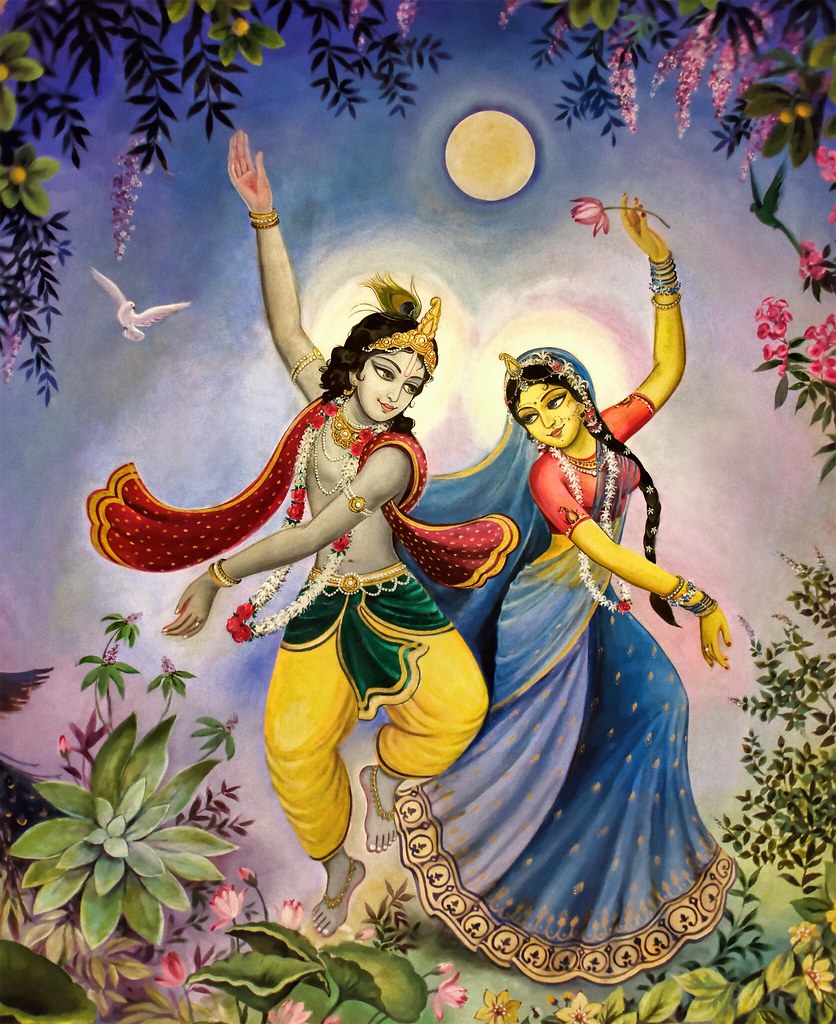
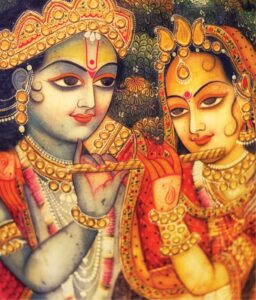
The celebration of Holi in the forests of Vraja is defined by the līlā, or divine play, of Rādhā and Kṛṣṇa. While other legends focus on the removing of global terror or the subduing of the ego, this tradition celebrates the height of spiritual ecstasy and the intimate bond between the individual essence or jīvātmā and the Supreme Being.
The Sacred Negotiation
As with many of our teachings, eternal realizations are conveyed through relatable pretexts. In this case, once upon a time, Rādhā, beloved for her kindness and known as a “friend to everyone,” initially hesitated to join the public Holi celebrations. She feared that the sheer volume of townspeople eager to throw color upon her would leave no room for an intimate celebration with Kṛṣṇa. Despite Kṛṣṇa’s invitations and promises of a Holī in seclusion, Rādhā remained in her home.
Dejected, Kṛṣṇa’s companions traveled to Rādhā’s town to convince her to emerge, only to be blocked by her protective circle of friends. What followed was a spirited, lighthearted, and cheeky debate filled with humor and wit. Upon hearing that Kṛṣṇa truly missed her, Rādhā secured a promise from their mutual friends that the two of them would indeed get to play together. This led to a joyous celebration in the village of Vṛndāvana, where the pair played Holī first with their inner circle and then with the entire community, ensuring that no one was left out of the “Colorful Festival of Love.”
The Visual Splendor of Vraja
In the Hindu Dharma traditions of the Vraja region, this celebration is described with breathtaking imagery. The gopīs (cowherd maidens) are said to have approached Rādhā to convince her to join the Lord of Vraja, who waited in a courtyard-garden anointed with red kuṅkuma and carrying a sprinkler of colored water.
As Rādhā set aside her desire to be alone, the forest was transformed. The sky and earth were colored by millions of fistfuls of fragrant powder thrown by the girls of Vraja. In the climax of this spiritual play, Kṛṣṇa is said to have expanded his form to be present with every person simultaneously—a manifestation of divine omnipresence within the intimate dance of the festival.
The Poetry of the Saints
For centuries, the Vaiṣṇava Hindu Dharma Sampradāyas (traditions)—including the Nimbārka, Puṣṭimārga, Haridāsī, and Rādhāvallabha—have preserved this legacy through song. The saint Śrībhaṭṭa (c. 1440–1520 CE) first wrote extensively of the pair playing along the banks of the Yamuna River, while Swāmī Haridāsa (c. 1478-1593) captured the tender, secluded moments between the “Kiśora and Kiśorī” (the youthful Divine Couple). He famously utilized the metaphor of the “slender golden vine” (Rādhā) clinging to the “dark Tamāla tree” (Kṛṣṇa) to describe their embrace. He sang of them slipping away from the rowdy crowds to find a sheltered bower in the thickest parts of the forest, where they could throw powder far apart from the gaze of the crowd.
A Universal Message
Later teachers like Viṭṭhalanātha (1518-1586) and Govindaswāmī (1505-1586) of the Puṣṭimārga Sampradāya continued this tradition of “Holī ke pada,” singing of being “drenched from head to toe” in the colors of Kṛṣṇa’s love. Ultimately, these stories signify that nature sees all as equal. When the colored powder falls, outward differences of status, wealth, or appearance vanish. Inspired by the divine archetypes of Rādhā-Kṛṣṇa, Sītā-Rāma, or Pārvatī-Śaṅkara, Holi becomes a time to recognize the essential nature of the soul, earning its title as the true Festival of Love.
Story 4: The Springtime Harvest
Beyond the vibrant pigments and the legends of kings and devas (illumined beings), Holi is fundamentally anchored in the rhythmic cycles of humans’ relationship with nature. For millennia, the rural heartlands of India have observed this festival as a sophisticated spiritual integration of the springtime transition—a collective celebration of the spring harvest and the survival of the winter season.
A Global Comparison
In many Indian farming communities, Holi signifies the conclusion of winter’s hardship. It serves as a visible “reset” button for the community whose powerful symbolism could be harnessed to remind humanity of existential truths. In this sense, it functions as an Eastern archetype for the American Thanksgiving, where the labor of the preceding months is finally manifested in tangible sustenance.
However, because the festival aligns with the rebirth of the natural world, it shares deeper thematic roots with traditions such as the Jewish Passover or the Christian Easter. These festivals all explore the intersection of physical renewal and spiritual fresh starts. For the Hindu practitioner, the harvest is not merely an economic event; it is a manifestation of the earth’s generosity and the cyclical nature of time.
Etymological Origins: From Grain to Glee
While contemporary popular culture often links the name “Holi” exclusively to the narrative of the rākṣasī Holikā, historical and linguistic evidence suggests another, more grounded origin. The name is derived from the ancient practice of roasting parched grains.
In the northern regions of Ancient India, the climate favored the cultivation of wheat and barley. To celebrate the harvest, communities would gather to roast freshly cut green grains over a central bonfire—a process that effectively incinerated the chaff and prepared the yield for consumption.
- Holā: The term for the half-ripe, green grains.
- Holaka: The ritual process of parching these grains together in a communal fire.
- Holakā: The original name for the festival itself, which only later became personified in the legend of Holikā who was consumed by the fire.
This ceremonial roasting is not merely a folk tradition but is codified in the Gṛhyasūtras (ancient instructional sources). These records date the practice to between 750 BCE and 400 BCE, providing a historical witness for a celebration that has likely existed for even longer. Hindus have been celebrating Holī for over 2,500 years!
Ecological Divergence: Indian Diversity
The vastness of the Indian subcontinent makes for variations in how the springtime transition is observed. The “Agni-centric” (fire-focused) ceremonies of most northern regions contrast with the ecological realities of southern regions.
- The Northern Grain Cycle: The focus remains on the parching of wheat and barley, utilizing the intense heat of the bonfire to process the harvest.
- The Southern Flowering Cycle: In South India, where rice and pulse harvests follow different timelines, the season of the Phālguna full moon is defined by the blooming of mango and neem trees. This environmental shift naturally aligns with the story of Kāmadahana—the “incineration of desire.” Here, the fire is seen as a transmuting force that clears the mind to appreciate the blossoming beauty of the world.
Social Egalitarianism and the Festival of Love
Every human society naturally gravitates toward groupings—whether based on shared tasks, ancestry, or even modern interests like sports and arts. Yet, human limitations often turn these differences into tools of discrimination. This stratification is a historical universal; no society has been exempt. The ancient seers of the Hindu Dharma traditions established Holi as a necessary ‘interruption’ to this reality. By associating equality with fun, food, and music, they created a space where joy and magnanimity replace the daily grind of social hierarchy. Holi serves as a recurring reminder: when pride or ambition blind us, we must return to the truth that every individual deserves dignity and respect, regardless of their grouping.
When the abīra and gulāla (colored powders) fills the air, outward markers of status, age, and social position are obscured. The result is a profound “social leveling.” This atmosphere is bolstered by festive music and the sharing of sweets crafted from the new harvest. By stripping away the ego through play, Holi reinforces the message that nature and the Supreme Being (Īśvara) view all beings with equal love.