

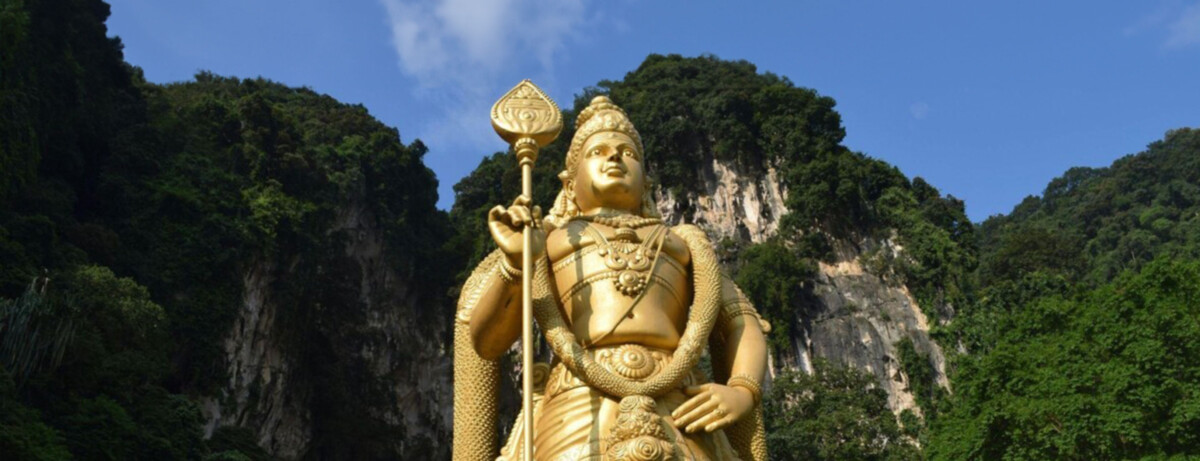
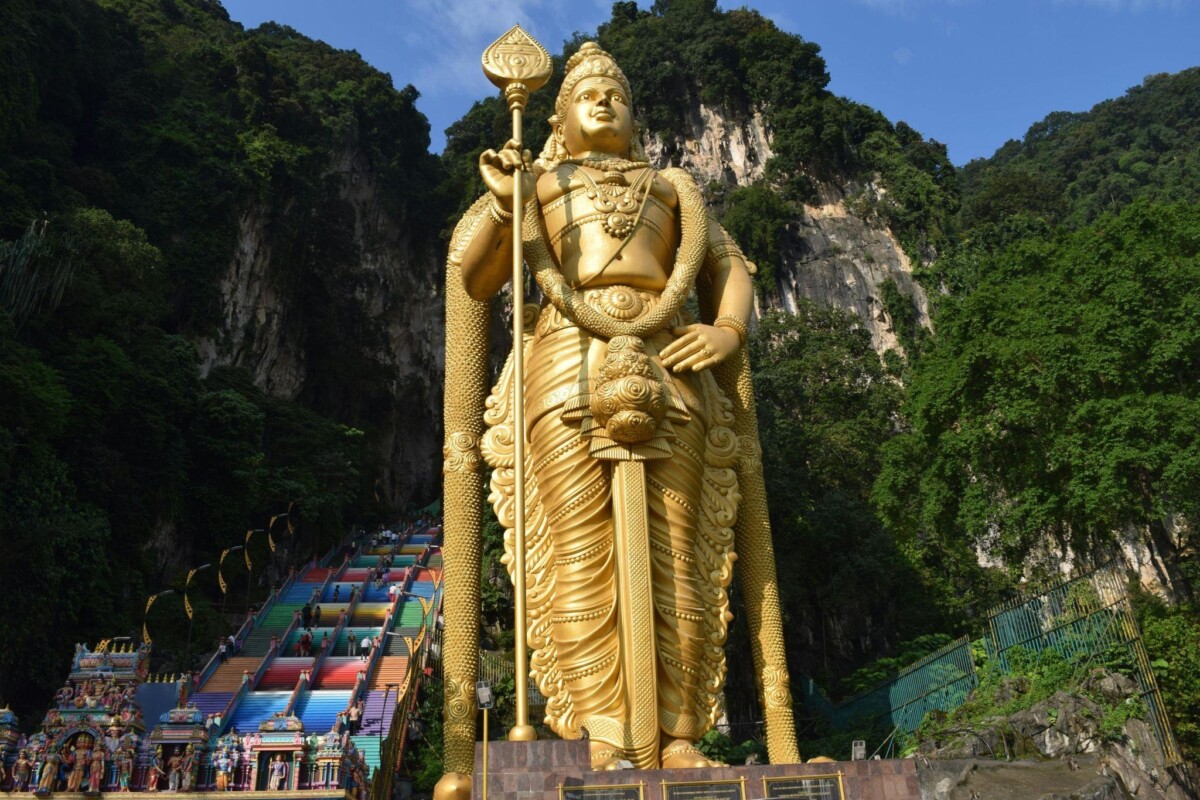
Towering at 140 feet, a golden statue of Murugan stands near the entrance of Malaysia’s Batu Caves, humbling the hearts of those who trek to see him.
He is the cherished hero of the Tamil people
India is made up of a wide spectrum of peoples going back to the ancient period, with roughly 4,400 tribes having populated the subcontinent. Though most eventually became part of the Vedic Aryas, whose metropolitan networks wove a common thread amidst their unique teachings and practices, many did so through their own sacred lens, retaining the diversity of the land’s different cultures.
Of these cultures, some of the more enduring and significant have been those of Tamil Nadu, which borders the Indian Ocean as the country’s southernmost state. Here, amidst the dance of traditions that make the Hindu Dharmas what they are today, ancestral customs are vast and varied, sharing a regional vocabulary that ties them all together. Indeed, an ecosystem all its own, it thrives by those who sustain it — their expressions flowing in a realm of icons, rooted in the classic works of Tamil literature.
According to the Tolkappiyam, the oldest surviving treatise on Tamil grammar and poetics, the region’s principal divinities corresponded to specific divisions of the natural world. Varunan presided over the seashore, Ventan over agriculture, Korravai over arid terrain, and Mayon over forests. And while each garnered respective followings as their legends took greater shape over time, it was Ceyon whose devotional stature rose above all others.
Presiding over mountains, the resources he symbolized were especially bountiful, including valleys, groves, rivers, and more. Thus evoking energy, resilience, prowess, and vigor, he is depicted as a strong and handsome youth, known best in the Tamil expanse as Murugan, “The Beautiful One.”
He’s not the “God of War” you think he is
Of course, Tamil Nadu isn’t the only place where Murugan is popular. Acknowledged and accepted by most of India’s sacred systems, he’s venerated in various ways across all the major Hindu streams.
For Shaivas, he’s a yogic guru, who guides one in union toward Shiva. For Shaktas, he’s a dynamic protector, who uplifts one in reverence for Devi. For Vaishnavas, he’s an upholder of truth, who supports one in devotion to the Supreme. For Smartas, he’s a spiritual anchor, who enlightens one in the all-pervasive oneness of the Divine.
And this is but the tip of the iceberg. Vast and varied as the Dharmic paths are, Murugan is known by many names throughout many schools of thought, including Skanda (“Leaper”), Subrahmanya (“Transparent”), Kandha (“Cloud”), and Senthil (“Victorious”). Even amongst Sri Lankan Buddhists he’s honored and respected, regarded as Kataragama Deviyo, a guardian of the island. Indeed highlighting his different qualities, each title is a tribute to his multifaceted nature. All exalt him in different ways. Yet, none does so quite like Kumara (“Youthful”), the root name of the Kaumaram Hindu Dharma traditions (one of the seven major ancient monotheist Hindu Dharma traditions).
Viewing him as the Supreme Being above all others, followers of this tradition are devoted to him with the utmost fervor. From Tamil Nadu, to Sri Lanka, to the diaspora in places like South Africa, Fiji, Malaysia, and North America, he’s more than a deva, or illumined being. He’s their all-in-all, their everything, who’s not only great and powerful, but an eternal youth, soft and gentle, presiding over childbirths, newlyweds, and bright and happy festivals.
Unfortunately, the wider world is unaware of the layered depths of his expansive character. Though colonial writers reduced him to a pagan “God of War,” a vast majority of his existence has nothing to do with bloodshed or battle. Yes, legends describe him as commander of the devas, charged with restoring balance to the universe. If you read on, however, you’ll find that his purpose in that role goes far deeper than what you might have imagined, as described in the story of his manifest appearance.
He is Shiva and Parvati’s son
Once, according to ancient texts (with varying detail, depending on the source), there was a tyrant named Surapadman who, through severe penance, achieved a boon that made him almost invincible.
Driven by arrogance, he and his brothers, Simhamukha and Tarakasura, wreaked havoc on the universe with the newly acquired powers, bringing destruction and despair to all in their wake. Try as they might, even the devas couldn’t stand against their dominion. And so Shiva, the great presider of universal transformation, was turned to for help.
Moved by their plight, Shiva resolved to beget an extraordinary warrior especially meant for Surapadman’s reckoning, emitting six fiery sparks without hesitation. Carried forth to a lake known as Saravana Pogai, they were divided amongst six lotus flowers, nurtured from there into six divine children.
Upon meeting the children, Shiva’s consort, Parvati, lovingly embraced them, merging all into one boy of six radiant faces. As these faces respectively corresponded to the mind and five senses, he possessed an acute sense of awareness, making him innately equipped for navigating conflict. Still, when the day came for him to face Surapadman, Parvati wanted to ensure Murugan’s victory. So arming him with a celestial spear known as the Vel, she readied him for battle, empowering him to dispel both corruption and ignorance.
His fight with the opposing army lasted several days, but in due course, Murugan proved unassailable. Vanquishing foe after foe — including Simhamukha and Tarakasura — he soon confronted Surapadman, who deployed the best of his abilities. Realizing he too was no match for the warrior’s divine strength, however, Surapadman eventually changed into a mango tree in a last ditch effort to evade him. But, of course, Murugan saw through the trickery, and with a swift strike of the Vel, split the tree in two, cementing the enemy’s defeat.
Yet, rather than die in the literal sense, Surapadman, it’s said, experienced the death of his pride and ego, transforming into a peacock of humility and rooster of selflessness. Thus showing forgiveness, Murugan took them into his company, accepting the first as his vahana (vehicle) and the second as his emblem. Before a harbinger of devastation, Surapadman now served as instruments in Murugan’s mission of peace and restoration — and that, ultimately, is what Murugan is all about.
Full of knowledge and devotion, his actions aren’t driven by lust, hate, fear, or anger. They are motivated by compassion, carried out for the well-being of all who are affected.
He is a symbol of spiritual harmony
Murugan has two consorts per various legends, both of whom reflect vital strands of the Tamil worldview.
The first, Devayani, is a daughter of Indra, king of the Vedic devas, who offered her in marriage as a gesture of gratitude following Surapadman’s defeat. Prudent, judicious, and regal in nature, she embodies the worldliness of the Vedic fold, shaped by codified systems, extensive frameworks, and far-reaching economic exchange. Valli, on the other hand, who became his second wife, was born to the indigenous, raised by a hunter-chieftain amidst the foothills of Kurinji. Wild, fearless, playful, and independent, she is a vivid expression of the tribal milieu, rooted in organic development, ecological balance, and self-sufficient living.
At first glance, Murugan’s connection with the latter might feel counterintuitive, especially since it was he who pursued her, a being of earthly ilk. Yet, in the unfolding of their courtship, one gleans an immutable bond, unbounded by the rules of duty and convention.
Valli, as it happened, had an affinity for Murugan from childhood, venerating him alongside the people of her clan. Seeing him as more than just the village icon, however, she honored him with a love and longing of the heart, untouched by the strictures of tradition. Moved by such devotion, Murugan eventually approached her, disguising himself in different forms to test her affection. And as she soon came to learn of his true identity, the two united in passion, eloping against all customs.
Now, heralded as their union is, it is by no means a disparagement of his first marriage, nor of the formalities surrounding it. Though Murugan’s love for Valli radiates an ecstatic and spontaneous ease, the devotion he shares with Devayani bears its own significance. Just as the rigors of scale practice enables one to express themselves freely on an instrument, life’s ceremonies and disciplines are integral to the evolution of our spiritual progress.
Thus highlighting the importance of both regimen and instinct, Murugan is a profound symbol of cultural harmony, blending the ways of local tribes with customs of the broader Vedic sphere. He is an example, through and through, that despite the natural wariness the Dharma traditions felt towards each other, they always tried to bridge the gap, displaying an overarching ethos of respect and plurality.
Thaipusam marks the pinnacle of his celebration
Popular as Murugan is, there are several festivals held in his honor.
Skanda Sashti, for example, commemorates his triumphs; Panguni Uttiram, his marriages; Vaikasi Visakam, his manifest appearance; and Aadi Krithigai, his upbringing. All are significant, underscoring various aspects of his pastimes and character. Still, none rival Thaipusam, observed under the full moon of Thai (January-February), when the brightest light shines during the darkest hour.
Generally speaking, two narratives stand at the heart of the festival, the first being Murugan’s aforementioned victory over Surapadman. Yet, more than the battle itself, focus is placed on the Vel as a harbinger of wisdom, emphasizing Murugan’s role in guiding followers towards clarity and discernment.
The second story, on the other hand, plays more into the physical practice of Thaipusam, taking place when the sage Agastya instructed his disciple Indumban to retrieve two hills, Sivagiri and Shaktigiri, from the Himalayas.
Tying them to the ends of a bamboo pole balanced across his shoulders, Idumban undertook the herculean task, though eventually grew tired from the arduous journey. Thus stopping along the way, he rested for some time, but when he made to lift them again, discovered that he couldn’t. A boy, he realized, was atop one of the peaks and refused to come down, inciting him to attack. Before Idumban knew it, however, he was struck down and defeated, as the child revealed he was no child at all, but Murugan himself, the presider of the region.
Humbled by the deva’s presence, Indumban begged forgiveness, but found, in truth, there was nothing to be forgiven for. Pleased, rather, by his courage and dedication, Murugan praised the hill-carrier, proclaiming from that day forth to bless all who followed in Idumban’s footsteps.
In hopes, therefore, of receiving such blessings, devotees all over the world observe Thaipusam by carrying a kavadi, or “ceremonial burden.” Emulating Idumban’s journey, they tie pots filled with offerings (like milk, fruit, or honey) on either side of a wooden pole, shouldering them long distances to various shrines of Murugan.
A process of spiritual cleansing, the strain is a welcomed burden, allowing them to deepen their devotion through discipline and austerity. And while everyone engages with the ceremony a little differently, all are united in a singular, intensive appeal to his compassion, making it an especially profound global celebration.